On the Job Market
I am currently on the academic job market and seeking faculty positions in Computer Science or Electrical Engineering, with a focus on Internet measurement, networking, and systems research. Feel free to reach out if you hear about any good fit! For more information, please see my faculty application materials.
I am a fifth-year Ph.D. candidate at Columbia University. My research develops rigorous models that piece together the hidden structure of the Internet from the fragments that can be directly observed. I focus on where visibility is most limited and where that lack of visibility most constrains our ability to improve the network: within private infrastructures, at the borders between networks, where users actually connect, and during performance degradations. The models I develop provide operators, researchers, and policymakers with the insights needed to diagnose problems more efficiently and build a more resilient network.
I work under the supervision of Professors Ethan Katz-Bassett, Vishal Misra, and Daniel Rubenstein.
Current Research Interests
- —Geometric Modeling of Network Connectivity
- —Topology Inference and Interconnection Discovery
- —Performance Tomography and Degradation Detection
- —Causal Inference for Network Behavior
- —Measurement-Driven Optimization
- —Geopolitics of Internet Infrastructure
Contact Information
Schapiro CEPSR 8th Floor
530 W 120th St
New York City, NY, 10027
Below are some of my selected publications. For a complete list, see my full publications page.
2024
-
metAScritic: Reframing AS-Level Topology Discovery as a Recommendation System
Proceedings of the 2024 ACM on Internet Measurement Conference, 2024
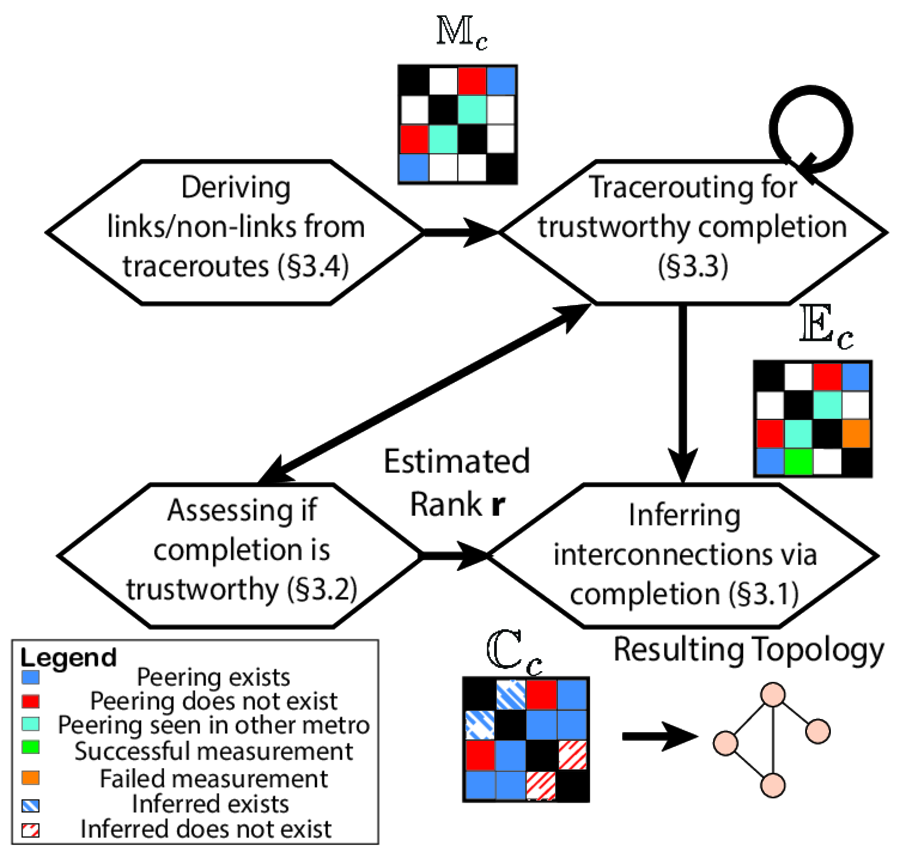
Despite prior efforts, the vast majority of the AS-level topology of the Internet remains hidden from BGP and traceroute vantage points. In this work, we introduce metAScritic, a novel system inspired by recommender system literature, designed to infer interconnections within a given metro. metAScritic uses the intuition that the connectivity matrix at a given metro is a low-rank system, since ASes employ similar peering strategies according to their infrastructures, traffic profiles, and business models. This approach allows metAScritic to accurately reconstruct the complete peering connectivity by measuring a strategic subset of interconnections that capture ASes’ underlying peering strategies. We evaluate metAScritic’s performance across six large metropolitan areas, achieving an average F-score of 0.88 on various validation datasets, including ground truth. metAScritic measures more than 86K edges and infers more than 368K edges, compared to the 13K edges observed for this subset of ASes in public BGP feeds – an increase of (24X) what is currently seen. We study the impact of our inferred links on Internet properties, illustrating the extent of the Internet’s flattening and demonstrating our ability to better predict the impact of route leaks and prefix hijacks, compared to relying only on the existing public view.
2023
-
A Manifold View of Connectivity in the Private Backbone Networks of Hyperscalers
Loqman Salamatian, Scott Anderson, Joshua Mathews, Paul Barford, Walter Willinger, and Mark Crovella
Commun. ACM, 2023
As hyperscalers such as Google, Microsoft, and Amazon play an increasingly important role in today’s Internet, they are also capable of manipulating probe packets that traverse their privately owned and operated backbones. As a result, standard traceroute-based measurement techniques are no longer a reliable means for assessing network connectivity in these global-scale cloud provider infrastructures. In response to these developments, we present a new empirical approach for elucidating connectivity in these private backbone networks. Our approach relies on using only "lightweight" (i.e., simple, easily interpretable, and readily available) measurements, but requires applying "heavyweight" mathematical techniques for analyzing these measurements. In particular, we describe a new method that uses network latency measurements and relies on concepts from Riemannian geometry (i.e., Ricci curvature) to assess the characteristics of the connectivity fabric of a given network infrastructure. We complement this method with a visualization tool that generates a novel manifold view of a network’s delay space. We demonstrate our approach by utilizing latency measurements from available vantage points and virtual machines running in datacenters of three large cloud providers to study different aspects of connectivity in their private backbones and show how our generated manifold views enable us to expose and visualize critical aspects of this connectivity.
2021
-
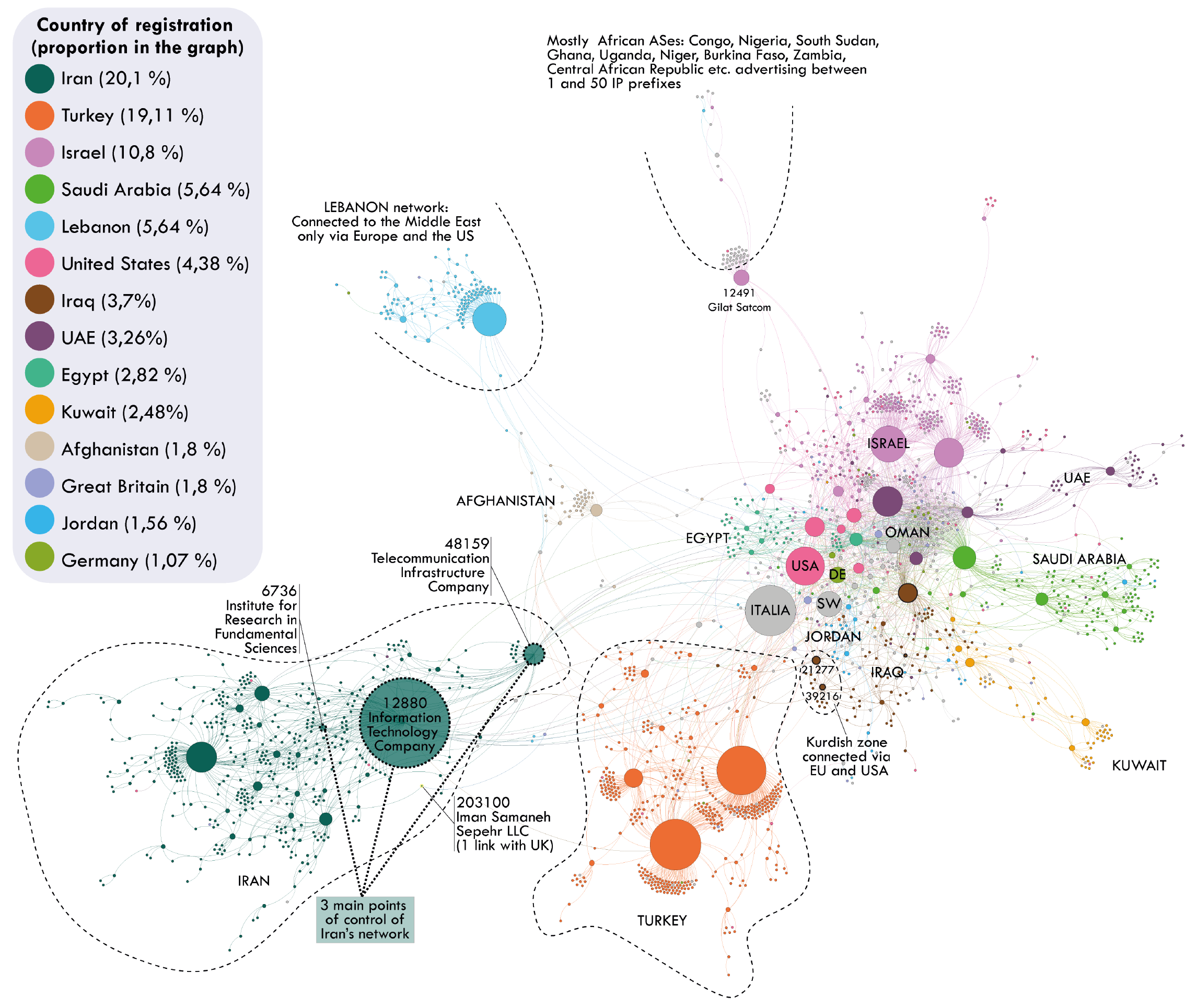
The geopolitics behind the routes data travel: a case study of Iran
Loqman Salamatian, Frédérick Douzet, Kavé Salamatian, and Kévin Limonier
Journal of Cybersecurity, 2021
In November 2019, in the wake of political demonstrations against the regime, Iran managed to selectively cut off most traffic from the global Internet while fully operating its own domestic network. It seemingly confirmed the main hypothesis our research had led us to, based on prior observation of data routing: Iran’s architecture of connectivity enables selective censorship of international traffic. This paper examines, through the case of Iran, how states can leverage the Border Gateway Protocol (BGP) as a tool of geopolitical control and what are the trade-offs they face. This question raises a methodological question that we also address: how the analysis of BGP can infer and document these strategies of territorialization of cyberspace. The Internet is a network of networks where each network is an autonomous system. Autonomous systems (ASes) are independent administrative entities controlled by a variety of actors such as governments, companies and universities. Their administrators have to agree and communicate on the path followed by packets travelling across the Internet, which is made possible by BGP. Agreements between ASes are often confidential but BGP requires neighbouring ASes to interact with each other in order to coordinate routing through the constant release of connectivity update messages. These messages announce the availability (or withdrawal) of a sequence of ASes that can be followed to reach an IP address prefix. In our study, we inferred the structure of Iran’s connectivity through the capture and analysis of these BGP announcements. We show how the particularities of Iran’s BGP and connectivity structure can enable active measures, such as censorship, both internally and externally throughout the network. We argue that Iran has found a way to reconcile a priori conflicting strategic goals: developing a self-sustaining and resilient domestic Internet, but with tight control at its borders. It thus enables the regime to leverage connectivity as a tool of censorship in the face of social instability and as a tool of regional influence in the context of strategic competition.
| Sep 15, 2025 | Three papers accepted at HotNets 2025! I am pleased to announce that three of our papers have been accepted for the 24th ACM Workshop on Hot Topics in Networks (HotNets 2025): - “A Breath of Fresh Air: Visualizing How Networks ‘Breathe’“ (with Stephen Jasina, Paul Barford, Mark Crovella, and Walter Willinger)
- “The Internet as Sisyphus: Repeating Measurements, Missing Causes” (solo author)
- “Unveiling and Engaging with the Humans of Networking Research” (with Nova Ahmed, Laura Gazda, Eric Greenlee, Shelby Hagemann, Kurtis Heimerl, Esther Jang, Fernanda Rosa, and Jason Young)
I look forward to presenting these works at HotNets 2025! |
| Jun 15, 2025 | Organizing Internet Visualization Exhibit (IVE)! I am pleased to announce that I am organizing the Internet Visualization Exhibit (IVE) non-paper session. This session will showcase innovative visualizations and interactive demonstrations of Internet measurement and topology data. IVE page |
| Nov 6, 2024 | Paper accepted at ACM HotNets 2024! I am pleased to announce that our paper “Toward Applying Quantum Computing to Network Verification” has been accepted at ACM HotNets 2024 (with Kahlil Dozier, Justin Beltran, Kylie Berg, Hugo Matousek, Ethan Katz-Bassett, and Dan Rubenstein). |
| Nov 1, 2024 | Two papers accepted at ACM IMC 2024! I am pleased to announce that two of our papers have been accepted at ACM IMC 2024: - “metAScritic: Reframing AS-Level Topology Discovery as a Recommendation System” (with Kevin Vermeulen, Italo Cunha, Vasilis Giotsas, and Ethan Katz-Bassett)
- “What’s in the Dataset? Unboxing the APNIC per AS User Population Dataset” (with Calvin Ardi, Vasileios Giotsas, Matt Calder, Ethan Katz-Bassett, and Todd Arnold)
I will be presenting both papers at ACM IMC 2024 in Madrid. |
| Apr 1, 2024 | Two papers accepted on Recycling Bloom Filters! I am pleased to announce that our two papers with Kahlil Dozier and Dan Rubenstein on estimating the upper and lower-bound of false positive and negative rates of Recycling Bloom Filters have been accepted at IEEE INFOCOM 2024 (for the false positive) and ACM SIGMETRICS 2024 (for the false negative). |
Currently on the academic job market! Best way to reach out is via e-mail or LinkedIn DM.